







Finding a mistake on your civil registry document is one of those moments that starts as a minor inconvenience and quickly becomes a pressing concern especially when you realize the error is blocking a passport application, a school enrollment, or an overseas job opportunity. Whether you spotted the problem while reviewing your PSA birth certificate online or a government agency flagged it during document verification, the important thing to know is this: errors on PSA birth certificates are correctable, the legal process is well-established, and thousands of Filipinos successfully navigate it every year.
This guide walks you through everything from identifying what type of error you have and which law applies, to filing the petition, gathering supporting documents, and eventually obtaining a corrected PSA birth certificate with the annotation reflecting your approved change.
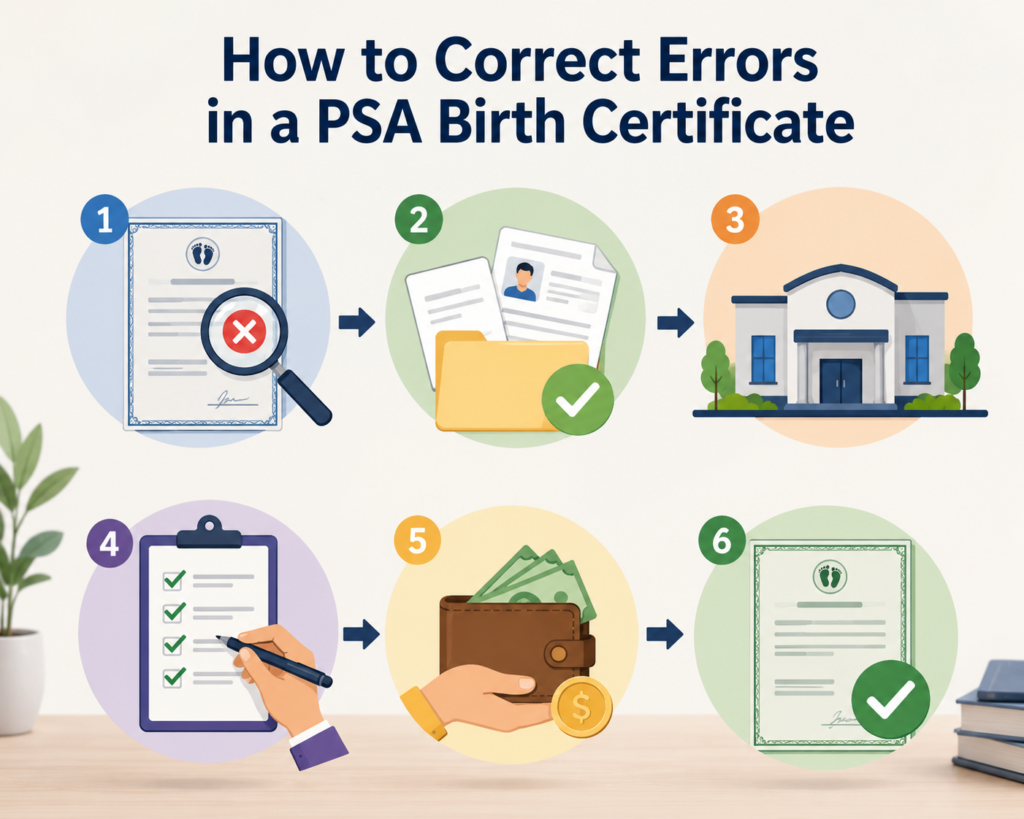
Step 1: Identify the Type of Error
Not all birth certificate errors are corrected the same way. Before doing anything else, look at the error carefully and determine what kind of mistake it is. This single step determines which legal process applies, how much it will cost, how long it will take, and whether you need a lawyer.
Philippine law classifies birth certificate corrections into two categories:
Category 1: Clerical or Typographical Errors
These are obvious mistakes that are inconsistent with other entries in the same document or with supporting records errors a reasonable person would immediately recognize as unintentional. Examples include:
- A name spelled as “Jonh” instead of “John”
- A birthplace recorded as “Cebu City” when the correct entry is “Cagayan de Oro City”
- A parent’s name that clearly has a letter missing or transposed
- Civil status of parents recorded incorrectly due to a typographical mistake
Category 2: Errors in Day/Month of Birth or Sex Entry
These are specific types of errors that appear factually significant but are treated as clerical errors if they are patently inconsistent with available records for example, a birth certificate that records sex as “Male” for a person with a clearly female name, or a birth month recorded as “March” when hospital records show “May.”
Category 3: Change of First Name or Nickname
This is not exactly an error correction, it is a formal petition to change a first name that causes embarrassment, is difficult to pronounce, or creates confusion. It follows the same administrative route as clerical corrections but with additional requirements, including newspaper publication.
Category 4: Substantial Errors Requiring Court Intervention
Some errors cannot be corrected administratively and require a judicial petition or a formal court case. These include:
- Correction of the year of birth
- Changes involving parentage who is listed as the mother or father
- Corrections affecting legitimacy or civil status
- Surname changes that go beyond a simple typographical fix
- Any change that alters the fundamental legal identity of the person
If your error falls into Category 4, the administrative process described in this guide does not apply. You will need to file a petition under Rule 108 of the Rules of Court and engage a lawyer.
Step 2: Know Which Law Applies to Your Correction
The type of error you identified in Step 1 maps directly to a specific Philippine law:
Republic Act 9048 (Clerical Error Law) covers Category 1 (clerical and typographical errors) and Category 3 (change of first name). This is an administrative process filed at the Local Civil Registry Office (LCRO) with no court order required.
Republic Act 10172 expands RA 9048 to cover Category 2 (errors in the day or month of birth and sex entry). Also an administrative process at the LCRO.
Rule 108 of the Rules of Court covers Category 4 (substantial corrections requiring judicial intervention). This requires filing a petition in the Regional Trial Court (RTC) with a lawyer.
For the vast majority of common birth certificate errors misspelled names, wrong birth month, wrong place of birth, incorrect sex entry RA 9048 and RA 10172 provide the administrative correction route. This guide focuses primarily on this route as it covers most situations.
Step 3: Go to the Correct Local Civil Registry Office
One of the most important and most frequently overlooked rules: you must file your correction petition at the Local Civil Registry Office (LCRO) of the city or municipality where the birth was originally registered, not the nearest LCRO to where you currently live.
If you were born in Davao City but now live in Quezon City, your petition must be filed at the LCRO of Davao City. If that is not practical, some LCROs accept what is called a migrant petition where you file at the LCRO nearest to your current residence and they coordinate with the LCRO of origin. This typically involves an additional service fee of approximately ₱1,000 but saves you from traveling back to your birthplace.
Confirm with your nearest LCRO whether they accept migrant petitions before visiting.
Step 4: Gather Your Supporting Documents
The strength of your correction petition depends entirely on the supporting documents you submit. The LCRO evaluator must be convinced that the information you are proposing is correct and the only way to do that is with consistent, credible records.
For Clerical or Typographical Error Corrections (RA 9048)
You generally need at least two or three public or private documents that consistently show the correct information. Common supporting documents include:
For name corrections:
- Baptismal certificate or church record
- School records Form 137, Form 138, or diploma
- Valid government-issued IDs (SSS, GSIS, PhilHealth, voter’s ID, passport, driver’s license)
- Employment records or company ID
- Marriage certificate (if applicable)
- Voter registration record
For place of birth corrections:
- Hospital or lying-in clinic birth records
- Barangay records or certificate of residence
- School records showing birthplace
General requirement for all petitions:
- Your current PSA birth certificate (the one with the error) order a fresh copy online via PSA online appointment
- A filled-out petition form from the LCRO
- Notarized affidavit supporting the petition
- Payment of filing fees
For Day or Month of Birth Corrections (RA 10172)
All of the above, plus:
- Hospital or medical records from the time of birth showing the correct date
- Baptismal certificate showing the correct date
- School enrollment records showing the correct date
For Sex Entry Corrections (RA 10172)
All standard documents, plus:
- Medical certificate from an accredited physician confirming biological sex this is a mandatory requirement
For Change of First Name (RA 9048)
All standard documents, plus:
- Evidence that the current name causes embarrassment, is difficult to pronounce, or has other compelling grounds for change
- Proof of publication after filing, the petition must be published in a newspaper of general circulation for two consecutive weeks.
Step 5: File the Petition at the LCRO
Once your documents are ready, visit the LCRO of the birthplace (or the LCRO accepting migrant petitions) and file your correction petition.
What happens at the LCRO:
- Request the Petition Form appropriate to your correction type the LCRO staff will direct you to the correct form based on what you’re correcting
- Fill out the petition completely and accurately
- Submit the petition form along with all supporting documents bring both originals and photocopies
- The LCRO evaluator will review your submission to confirm the documents are sufficient and consistent
- Pay the filing fee typically ₱1,000 to ₱3,000 depending on the type of correction and the specific LGU’s fee schedule. For combined RA 9048 and RA 10172 corrections on the same document, only one fee of approximately ₱3,000 applies
- Receive your official receipt and a tracking reference for your petition
If the evaluator finds that your supporting documents are insufficient, they will advise you on what additional records are needed before the petition can be accepted. Do not submit incomplete petitions; a rejected petition means starting the process over.
Step 6: Publication Requirement (For First Name Changes Only)
For clerical and typographical error corrections and sex/date corrections under RA 10172, there is no newspaper publication requirement, only a bulletin board posting at the LCRO for at least 10 consecutive days.
However, for first name change petitions under RA 9048, mandatory newspaper publication is required. The petition must be published once a week for two consecutive weeks in a newspaper of general circulation. The LCRO will advise you on accredited newspapers in your area. Publication fees typically range from ₱5,000 to ₱12,000 or more depending on the newspaper and region.
To keep copies of both published newspaper notices you will need to present the Affidavit of Publication to the LCRO as proof that the publication requirement was fulfilled.
Step 7: Wait for LCRO Evaluation and Approval
After your petition is filed, the LCRO Civil Registrar reviews the petition and all submitted documents. The evaluator checks for:
- Consistency between the correction being requested and the supporting documents
- No conflicting records in the civil registry
- Proper completion of all required forms
- Compliance with all procedural requirements
If the petition is approved, the LCRO endorses the approved correction to the Office of the Civil Registrar General (OCRG) , the PSA’s central civil registry for annotation and national database updating.
Processing time at the LCRO level: typically 1 to 3 months from the date of petition filing, depending on the LCRO’s caseload and the complexity of the correction.
If the petition is denied, you will be notified and given the grounds for denial. You may reapply with additional supporting documents or, for certain corrections, escalate to a judicial petition.
Step 8: Wait for PSA Database Updating
After the LCRO endorses the approved correction to the OCRG, the PSA encodes the annotation into the national civil registry database. This step adds additional time after the LCRO approval.
PSA database updating after an approved LCRO correction typically takes an additional 1 to 3 months bringing the total wait time from petition filing to PSA database update to approximately 3 to 6 months for straightforward administrative corrections.
For first name changes with publication requirements, the total timeline is often closer to 6 to 9 months due to the publication window and additional review period.
Step 9: Order Your Corrected PSA Birth Certificate
Once the correction has been encoded in the PSA database, you can request your new, corrected PSA birth certificate. The corrected copy will carry an annotation a notation on the document indicating:
- What was corrected
- The date the correction was approved
- The legal authority under which it was made (RA 9048, RA 10172, or a court order number for judicial corrections)
The annotated copy is the official, legally valid version of your birth certificate going forward. All future transactions should use this annotated copy.
How to order your corrected PSA birth certificate:
- Online: Go to psabirthcertificate.ph, select Birth Certificate, enter the corrected name and details, pay ₱365, and wait for delivery
- Walk-in: Visit any PSA Serbilis or CRS outlet with your valid ID and pay ₱155
Always order the corrected version using the new, corrected information, not the old erroneous details. If you try to order using the old name or details, the system may return the old uncorrected version or an unmatched result.
Special Cases and Considerations
Filing a Correction for Someone Who Has Passed Away
Corrections to a deceased person’s birth certificate needed for estate settlement, inheritance, or historical record purposes can be filed by an immediate family member. The process is the same as a standard correction, with the filing party bringing their own ID and documentation establishing their relationship to the deceased.
Filing From Abroad
Filipinos based overseas can file correction petitions through the nearest Philippine Embassy or Consulate. The consular post coordinates with the LCRO of the birthplace. Fees are denominated in the local currency at the consular post’s current rates. Processing times are longer than domestic filings due to international coordination.
Corrections on Birth Certificates Issued Abroad (Report of Birth)
If the birth was registered as a Report of Birth through a Philippine Embassy or Consulate, corrections must be filed through the OCRG, not a local LCRO. Contact the PSA’s OCRG directly or through the relevant Philippine foreign post for guidance regarding your PSA birth certificate correction requirements.
What to Do While Waiting for the Correction to Be Processed

During the 3 to 6 months of processing, you may need to use your birth certificate for transactions that cannot wait. In these cases:
- Present the LCR-certified copy of the filed correction petition as evidence that a correction is in progress
- Prepare an Affidavit of Discrepancy or Affidavit of One and the Same Person to explain the difference between your birth certificate and other documents
- Contact the specific agency to explain the situation. Most government offices and schools will accommodate pending correction cases with appropriate documentation.
Complete Cost Summary
| Correction Type | Filing Fee | Publication | Medical Cert | Total Estimate |
| Clerical/typographical error | ₱1,000–₱3,000 | Not required | Not required | ₱1,500–₱4,000 |
| Day/month of birth (RA 10172) | ~₱3,000 | Not required | Not required | ₱3,500–₱5,000 |
| Sex correction (RA 10172) | ~₱3,000 | Not required | ₱500–₱2,500 | ₱4,000–₱7,000 |
| First name change (RA 9048) | ~₱3,000 | ₱5,000–₱12,000 | Not required | ₱8,000–₱15,000+ |
| Judicial correction (Rule 108) | ₱2,000–₱10,000+ court fees | ₱5,000–₱15,000 | Varies | ₱40,000–₱150,000+ |
All fees are estimated and vary by LGU, specific LCRO, and document requirements. Confirm exact amounts with your LCRO before filing.
Frequently Asked Questions
How do I know if my error qualifies for administrative or judicial correction?
If the error is a spelling mistake, a wrong birth month or day, an incorrect sex entry, or a wrong place of birth it is almost certainly administrative under RA 9048 or RA 10172. If the error involves a wrong year of birth, parentage, legitimacy, or a surname change that changes your identity it requires judicial correction under Rule 108. When in doubt, consult your LCRO before filing anything.
Can I file the correction myself without a lawyer?
For administrative corrections under RA 9048 and RA 10172 yes. A lawyer is not required. LCRO staff can guide you through the process. For judicial corrections under Rule 108, you need legal representation.
What if the LCRO rejects my petition?
Review the grounds for rejection carefully. In most cases, the LCRO will tell you what additional documents are needed. Submit the supplemental documents and refile. If the rejection is based on the type of error not qualifying for administrative correction, you may need to escalate to a judicial petition.
Will the annotation show on my PSA birth certificate permanently?
Yes. The annotation is a permanent part of the document and will appear on every copy ordered after the correction. It confirms the correction was made through a proper legal process; this is not a negative mark but a legal notation.
My name on my PSA birth certificate is different from my passport. Do I need to correct the birth certificate?
Not necessarily for all transactions an Affidavit of One and the Same Person can resolve minor discrepancies for many purposes. However, for immigration, naturalization, and certain government transactions, the names must match exactly. Correcting the birth certificate to match your passport (or vice versa) is the most permanent solution.
Final Thoughts
Correcting an error on a PSA birth certificate takes time and requires careful preparation but it is a well-mapped legal process that thousands of Filipinos complete successfully every year. The most critical steps are identifying the correct legal route for your type of error, gathering consistent and credible supporting documents, and filing the petition at the right LCRO.
Start the process as early as possible well before any deadline that depends on the corrected document. A 3 to 6-month timeline is typical for administrative corrections, and any delay in filing translates directly into a delay in having the corrected document available.
Once the correction is processed and your annotated PSA birth certificate is in hand, every future transaction becomes smoother with a document that accurately reflects your legal identity and can be presented with full confidence to any agency, institution, or immigration authority in the Philippines or abroad.