










As 100G connectivity becomes standard across enterprise and metro-access networks, 100G IR4 modules have emerged as a cost-effective solution for reaches up to 2 km over single-mode fiber (SMF). At the heart of the 100G IR4 design is CWDM-based wavelength allocation, which enables four parallel 25G optical lanes to coexist on a single fiber pair. Understanding how these wavelengths are structured and how they differ from LR4’s LAN-WDM approach is essential for proper network design and deployment.
The 4×25G Architecture Behind 100G IR4
A 100G IR4 module transmits data using four independent 25 Gbps electrical lanes from the host interface. Internally, these lanes are converted into four optical signals, each operating on a different CWDM wavelength. The module then multiplexes these four wavelengths onto a single transmit fiber and demultiplexes them on the receive side.
Unlike parallel optics (such as SR4), IR4 uses wavelength division multiplexing (WDM) over duplex single-mode fiber. This reduces fiber count while maintaining manageable module complexity and power consumption.
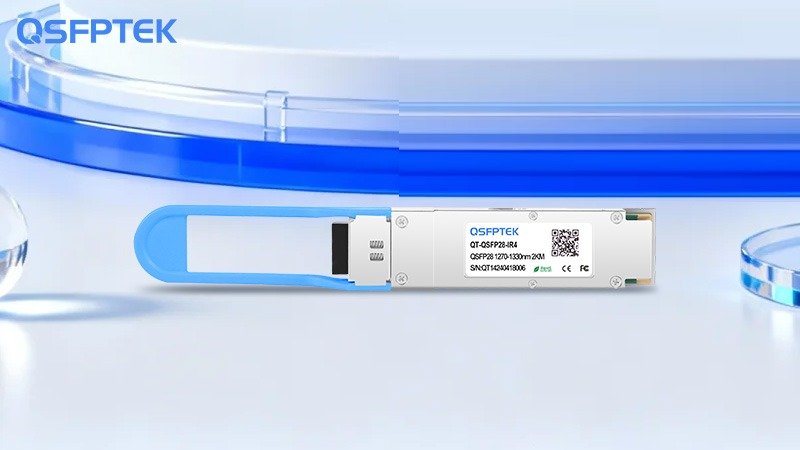
CWDM Wavelength Allocation in IR4
CWDM (Coarse Wavelength Division Multiplexing) uses relatively wide wavelength spacing. In typical 100G IR4 modules, the four wavelengths are located within the 1270 nm to 1330 nm range. A common allocation includes:
1271 nm
1291 nm
1311 nm
1331 nm
These wavelengths are spaced approximately 20 nm apart. The wide channel spacing is a defining feature of CWDM technology and directly influences module design, optical filtering requirements, and overall system tolerance.
Because of the larger spacing, CWDM systems can use less complex temperature control and optical filtering mechanisms compared to dense WDM systems. This contributes to the relatively lower cost and simpler design of IR4 modules.
Why Wavelength Spacing Matters
The 20 nm spacing in CWDM reduces channel interference and simplifies multiplexing. Wider spacing means:
Less stringent wavelength stability requirements
Reduced cross-channel crosstalk
Lower filtering precision is needed in the mux/demux components
However, this wider spacing also means fewer available channels within a given spectral band compared to denser technologies.
In a 100G IR4 module, the objective is not to maximize spectral efficiency, but to achieve reliable short-to-intermediate reach transmission with reasonable cost and power consumption. For distances up to 2 km, CWDM spacing provides a practical balance between performance and implementation complexity.
CWDM in IR4 vs LAN-WDM in LR4
While QSFP28 IR4 and 100G LR4 both use four wavelengths over duplex SMF, their wavelength strategies differ significantly.
100G LR4 typically uses LAN-WDM wavelengths around 1295 nm to 1309 nm, with much narrower channel spacing, approximately 4 to 5 nm. This tighter spacing allows all four channels to fit within a smaller spectral window, improving compatibility with certain optical transport systems.
However, narrower spacing requires:
More precise wavelength control
Higher-quality optical filters
Stricter temperature stabilization
As a result, LR4 modules tend to have slightly higher complexity and may involve tighter design tolerances compared to IR4 modules.
In practical deployment terms, IR4 is optimized for shorter reach (around 2 km), while LR4 supports up to 10 km. The wavelength strategy reflects these design goals.
Dispersion Considerations
Chromatic dispersion increases with transmission distance and varies across wavelengths. Because CWDM IR4 operates over a relatively short 2 km span, dispersion impact is minimal and well within system tolerance. The wider spacing of CWDM wavelengths does not introduce significant additional dispersion challenges at this distance.
In contrast, LR4 modules designed for 10 km operation must account more carefully for chromatic dispersion effects due to longer fiber spans and tighter wavelength spacing. Although both operate in the O-band region where dispersion is naturally lower than in the C-band, longer reach increases sensitivity.
Conclusion
The CWDM wavelength allocation in 100G IR4 modules, based on four 25G lanes spaced approximately 20 nm apart, prioritizes simplicity, cost efficiency, and reliable short-range transmission. Compared to the tighter LAN-WDM approach used in LR4 modules, IR4’s wider spacing reduces design complexity while meeting the performance requirements of campus and metro-access networks.